







Bringing Financial Security to Africa's Middle Class: Inside Oluwatobi Adewale-Temowo's Journey Building Grox
Africa is home to a rising young, middle class population eager to participate in the global economy. But wealth erosion, inflation, and fragmented financial tools are preventing many people from building personal wealth and saving for retirement.
Progressive fintech and crypto offerings expose users to more risk than they can manage, and traditional banks often fail to beat inflation. Meanwhile, navigating the complex financial landscape requires expertise that many people don’t currently have.
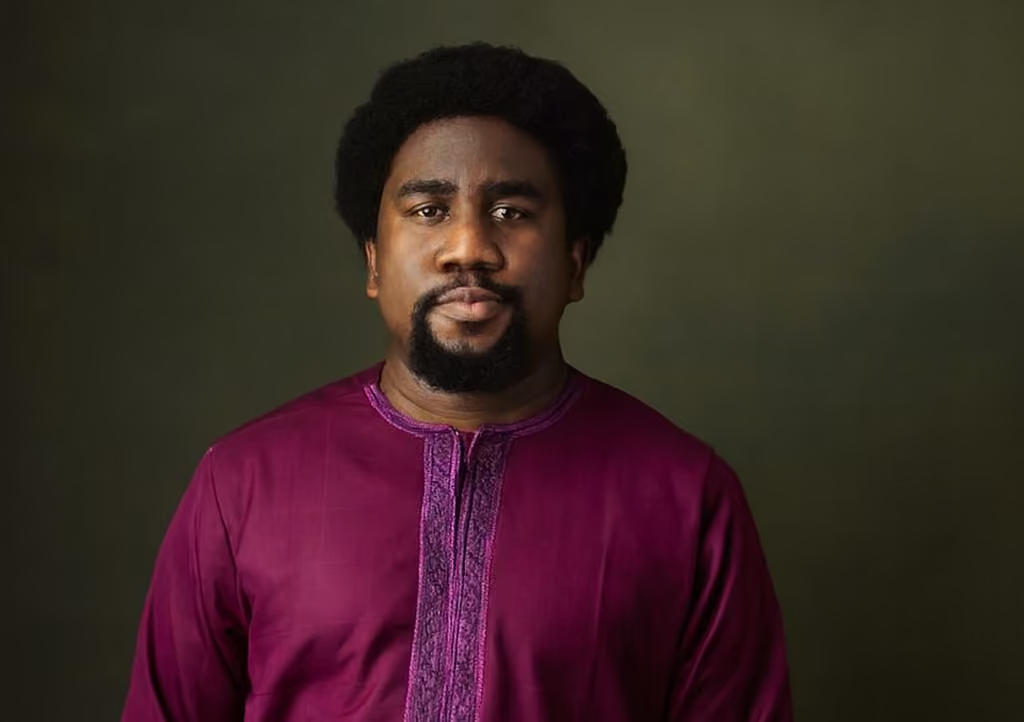
After spending a decade working across Africa’s fintech ecosystem, Oluwatobi Adewale-Temowo was tired of hearing countless stories of hardworking Africans unable to secure their financial future. So he set out to build Grox, Africa’s first digital currency.
Introducing Grox: A New Kind of Money for African Markets
Grox is a digital asset and fintech platform that provides a suite of financial services built around asset-backed stability. Providing users with a single platform for investing, payments, trading, and currency swaps, Grox is positioning itself as Africa’s premier solution for wealth management.
The center of Grox’s offering is a digital token backed by a strategic mix of liquid cash reserves and diversified low-risk appreciating assets, including government bonds, treasury bills, money markets, equities, fixed deposits, and real estate.
Unlike volatile cryptocurrencies, Grox’s token is designed for stability and steady growth. And while savings offerings of traditional banks often fail to match inflation, Grox’s token is built to target 15-25%+ annual returns. That means that whether users are budding investors, small businesses, or everyday people, they can use Grox to protect their savings and grow their net worth.
In addition to wealth-building, Grox also enables users to manage their money. Cross-border payments, currency swaps, and stablecoin trading make it possible for users to handle all their financial needs within a single platform instead of having to juggle multiple banking and fintech tools.
Just a year in, Grox is already finalizing their MVP and has built a waitlist of over 300 users.
Oluwatobi’s Journey to Grox
After studying English at University, Oluwatobi found his way into fintech by joining two YC-backed startups, first Kudi (now Nomba) and second Sanwo (now Touch and Pay). He spent years working as a generalist across product, growth, strategy, and expansion, getting a front-row seat to Africa’s rapidly-expanding fintech landscape.
But when COVID hit, many Africans’ were left without a financial safety net. The combination of health risks, inflation, and financial knowledge gaps led many to lose their savings and derail their financial futures.
Oluwatobi’s priorities changed when he heard the story of a primary school teacher who had worked and saved for 35 years, only for her pension to be worthless by the time she retired. "What can I do using relevant technology and my experience to solve this?" he asked. And the vision for Grox was born.
In the long run, Oluwatobi aims for Grox to provide a platform for wealth-building across Africa while also positioning itself as the default layer for wealth protection, payments, and money movement in the continent.
Oluwatobi’s Advice for Fellow Founders
Oluwatobi founded Grox to build a better finance solution for the people of Africa, and his key driver for decision-making has been conversations with everyday Africans themselves. "You must talk to users,” he says. “I speak to users every day, speak to drivers and ask them what they think. And that helps me find the idea."
It’s important to use these conversations to validate ruthlessly, he says. And in doing so, founders must note that people can have a real problem and still not be willing to pay to solve it—it’s critical not to conflate the two. To find product market fit, you must be able to solve a real problem, and the problem must be something that people are willing to pay to have solved.
To learn more about Oluwatobi's founder journey, you can follow him on LinkedIn and visit usegrox.com.
Up to 3,500 bonus and 3% cash-back on all card spend [3], 6 months off payroll, and 50% off bookkeeping for 6 months, free R&D credit.
Frequently Asked Questions
- How do I sign up for Every?
You can get started right away—just click “Get Started” and follow a short onboarding flow. Prefer a little help? One of our specialists can walk you through incorporation, banking, payroll, accounting, or whatever you need.
- What features does Every offer?
Every gives startups a complete back office in one platform. From incorporation and banking to payroll, bookkeeping, and tax filings, we take care of the operational heavy lifting—so you can spend more time building, less time managing.
- How is Every different from other tools?
Most competitors give you software. Every gives you a full-stack finance and HR team—plus smart financial tools that actually benefit founders. Earn up to 4.3% interest on idle cash and get cash back on every purchase made with your Every debit cards, routed straight back to you.
Every is not a bank. Banking services provided by Thread Bank, Member FDIC. Your deposits qualify for up to $3,000,000 in FDIC insurance coverage when Thread Bank places them at program banks in its deposit sweep program. Pass-through insurance coverage is subject to conditions. The Every Visa Business Debit Card is issued by Thread Bank, Member FDIC, pursuant to a license from Visa U.S.A. Inc. and may be used anywhere Visa cards are accepted.
- Is my data secure with Every?
We use end-to-end encryption, SOC 2-compliant infrastructure, and rigorous access controls to ensure your data is safe. Security isn’t a feature—it’s foundational.
Can I switch to Every if my company is already set up?Yes—you can switch to Every at any time, even if your company is already incorporated and running. Whether you're using separate tools for banking, payroll, bookkeeping, or taxes, we’ll help you bring everything into one place. Our onboarding specialists will guide you through the process, make sure your data is transferred cleanly, and get you set up quickly—without disrupting your operations. Most founders are fully transitioned within a week.
- What stage of startup is Every best for?
Every is designed for startups from day zero through Series A and beyond. Whether you're just incorporating or already running payroll and managing expenses, we meet you where you are. Early-stage founders use Every to get up and running fast—with banking, payroll, bookkeeping, and taxes all handled from day one. Growing teams love how Every scales with them, replacing patchwork tools and manual work with a clean, unified system.
We’re especially valuable for teams who want to move fast without hiring a full finance or HR team—giving founders more time to build, and fewer distractions from admin and compliance
- How long does onboarding take?
Onboarding with Every is fast and efficient. For most startups, the process typically takes between 3 to 7 days, depending on your specific needs and how much setup you already have in place.
If you're a new company, you'll be up and running quickly—getting your banking, payroll, and bookkeeping set up without hassle. If you’re transitioning from another system, our specialists will help you migrate your data, ensuring a smooth switch with no gaps or errors in your operations.
We guide you every step of the way, from incorporation to setting up automated payroll to handling your taxes—so you can focus on growing your business. Our goal is to make sure you're fully operational and confident in your back office in under a week.
Practical Questions to Ask to Ensure Your Bank is Well Managed
How much liquidity does the bank have on hand to cover unexpected withdrawals or shortfalls?
What percentage of the bank's deposits are invested in longer-term securities and loans, and what percentage is kept as cash reserves?
How does the bank diversify its investment portfolio to minimize potential losses and reduce risks?