








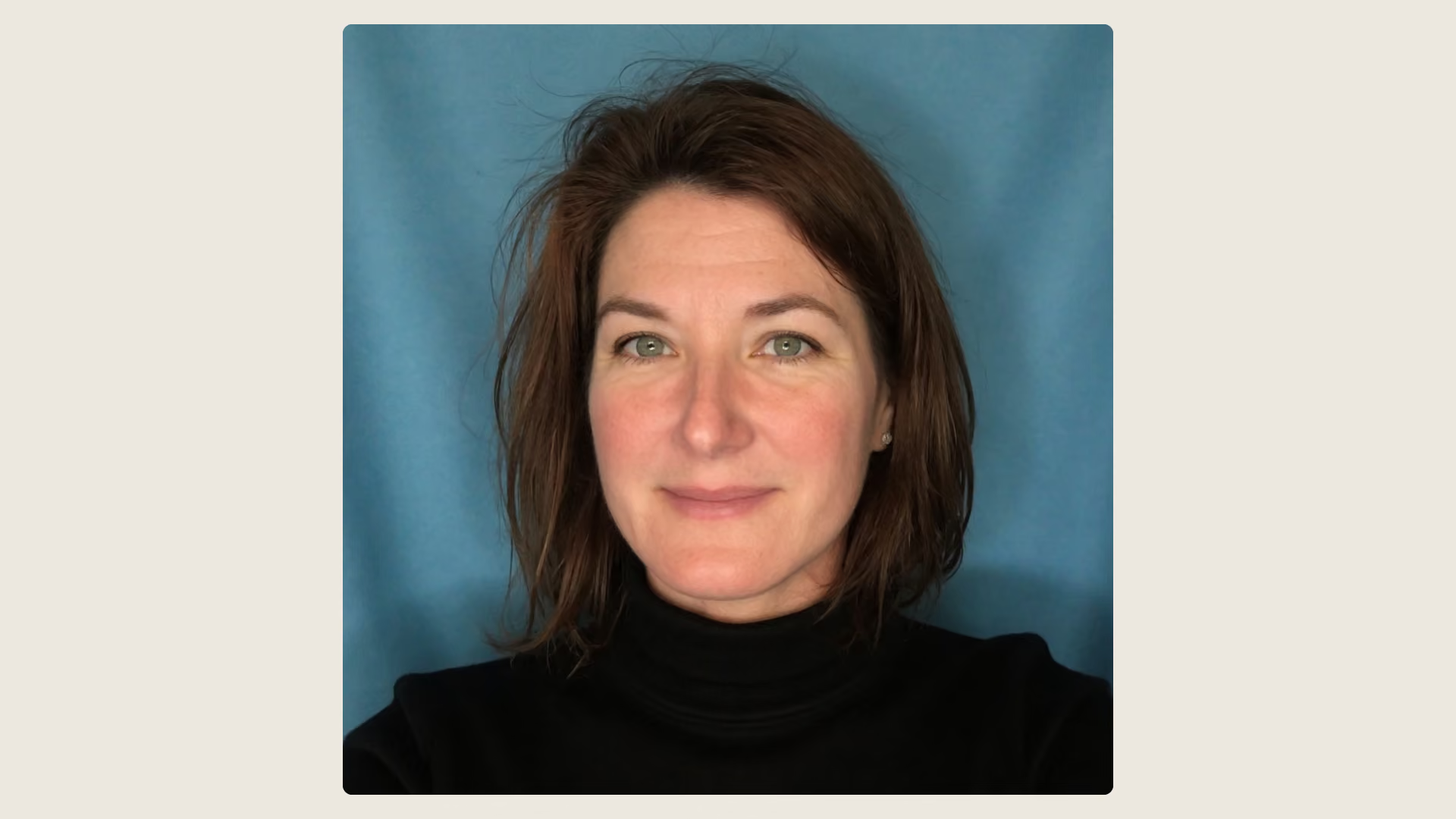
Lisa Wright is Building Landings, The Infrastructure for the Future of Air Mobility
Electric aviation is advancing and beginning to provide a viable alternative to traditional aircraft, especially in commercial transport, passenger travel, and emergency response. But as electric aircraft require charging facilities and take off and land vertically, they need their own infrastructure to operate.
As a licensed architect with years of experience working in property tech, Lisa Wright became fascinated by the evolution of electric aviation and the ways it could be integrated into our lives. So she set out to build Landings and create the infrastructure for electric aviation across America.
Introducing Landings: Bringing Advanced Air Mobility to Everyone
Landings is building a network of landing and charging vertiports for electric aircraft and commercial drones. The locations are built to support vertical takeoff and landing for agricultural drones, first responder aircraft, and future EVTOL passenger and freight transport, and to provide charging infrastructure for these different types of aircrafts.
Although electric aircraft activity is increasing across the country, Lisa and the team have focused their initial efforts on building out a network of stations in Mohawk Valley, New York. With 12 stations in the region thus far, the team aims to partner with aircraft manufacturers, support electric aircraft adoption, and provide jobs to local communities.
Over the next ten years, Landings aims to establish a coast-to-coast network, with over 2,000 stations from Canada to the Caribbean, making electric aviation more accessible to communities across the country.
Lisa’s Journey to Landings
Lisa began her career as a licensed architect, building commercial projects across the world. After fifteen years, she expanded her focus to Operations and Technology, advising several startups and joining PropTech startup Knotel.
But when the COVID-19 pandemic upended the property market overnight, Knotel struggled and was acquired by Newmark as an internal service provider, and Lisa found herself at a fork in the road. “Even though the startup role was very rocky, I loved the work and I loved the people that I worked with. They all had this founder's mindset. So I thought, why don't I do something for myself?"
Having been interested in the development of electric aircrafts for years, Lisa recognized it was her moment to take a chance and build a solution in the space. She began by reaching out to 40+ regional development organizations across the Northeast to communities that would be receptive to electric aircraft adoption. But when she discovered that the Mohawk Valley already had FAA-approved drone airspace between Syracuse and Albany, she knew the region would be the ideal place to get started.
Lisa’s Advice for Fellow Founders
Although Lisa has surrounded herself with a network of great advisers, she notes that sometimes, as a founder, it’s best to follow your gut instead of conventional advice.
“My biggest learning so far has been to authentically follow the thing that I want to follow,” Lisa explains. “A lot of people told me not to focus on rural areas. Everybody talks about flying from Manhattan to JFK, but I don’t fit into that. When an advisor noted that I speak passionately about the supporting rural community, I knew I had to focus there. That really freed me up from hedging and second-guessing about something I feel so strongly about.”
Passion is infectious, and by following your authentic vision, you’re able to speak more powerfully about the solutions you’re developing and attract people that align.
And as you progress, Lisa notes, don’t be afraid to ask for help. “For the first 20 years of my career I built great working relationships, and since launching Landings I've gotten an incredible amount of support from them—whether it's office space or helping me hire interns for the summer. Surround yourself with smart, good people, and don't be afraid to ask them for help when you need it."
To learn more about Lisa’s journey, you can follow her on LinkedIn and visit Landings.co.
Up to 3,500 bonus and 3% cash-back on all card spend [3], 6 months off payroll, and 50% off bookkeeping for 6 months, free R&D credit.
Frequently Asked Questions
- How do I sign up for Every?
You can get started right away—just click “Get Started” and follow a short onboarding flow. Prefer a little help? One of our specialists can walk you through incorporation, banking, payroll, accounting, or whatever you need.
- What features does Every offer?
Every gives startups a complete back office in one platform. From incorporation and banking to payroll, bookkeeping, and tax filings, we take care of the operational heavy lifting—so you can spend more time building, less time managing.
- How is Every different from other tools?
Most competitors give you software. Every gives you a full-stack finance and HR team—plus smart financial tools that actually benefit founders. Earn up to 4.3% interest on idle cash and get cash back on every purchase made with your Every debit cards, routed straight back to you.
Every is not a bank. Banking services provided by Thread Bank, Member FDIC. Your deposits qualify for up to $3,000,000 in FDIC insurance coverage when Thread Bank places them at program banks in its deposit sweep program. Pass-through insurance coverage is subject to conditions. The Every Visa Business Debit Card is issued by Thread Bank, Member FDIC, pursuant to a license from Visa U.S.A. Inc. and may be used anywhere Visa cards are accepted.
- Is my data secure with Every?
We use end-to-end encryption, SOC 2-compliant infrastructure, and rigorous access controls to ensure your data is safe. Security isn’t a feature—it’s foundational.
Can I switch to Every if my company is already set up?Yes—you can switch to Every at any time, even if your company is already incorporated and running. Whether you're using separate tools for banking, payroll, bookkeeping, or taxes, we’ll help you bring everything into one place. Our onboarding specialists will guide you through the process, make sure your data is transferred cleanly, and get you set up quickly—without disrupting your operations. Most founders are fully transitioned within a week.
- What stage of startup is Every best for?
Every is designed for startups from day zero through Series A and beyond. Whether you're just incorporating or already running payroll and managing expenses, we meet you where you are. Early-stage founders use Every to get up and running fast—with banking, payroll, bookkeeping, and taxes all handled from day one. Growing teams love how Every scales with them, replacing patchwork tools and manual work with a clean, unified system.
We’re especially valuable for teams who want to move fast without hiring a full finance or HR team—giving founders more time to build, and fewer distractions from admin and compliance
- How long does onboarding take?
Onboarding with Every is fast and efficient. For most startups, the process typically takes between 3 to 7 days, depending on your specific needs and how much setup you already have in place.
If you're a new company, you'll be up and running quickly—getting your banking, payroll, and bookkeeping set up without hassle. If you’re transitioning from another system, our specialists will help you migrate your data, ensuring a smooth switch with no gaps or errors in your operations.
We guide you every step of the way, from incorporation to setting up automated payroll to handling your taxes—so you can focus on growing your business. Our goal is to make sure you're fully operational and confident in your back office in under a week.
Practical Questions to Ask to Ensure Your Bank is Well Managed
How much liquidity does the bank have on hand to cover unexpected withdrawals or shortfalls?
What percentage of the bank's deposits are invested in longer-term securities and loans, and what percentage is kept as cash reserves?
How does the bank diversify its investment portfolio to minimize potential losses and reduce risks?