









New: Tracking Your Employees' Time Off
You already know you need a policy for vacation and sick time — what you may not know is that each state, and even some cities, have different requirements for vacation and sick time off that you need to comply with.
Those rules cover accrual rates, minimum balances, carryover, and what you owe someone on termination — and they don't stay still. A policy that was compliant last year in a given state might not hold up today.
The problem with how most companies handle this
Without a system, time off tracking usually means a spreadsheet for balances, a shared calendar so people know who's out, and someone manually reconciling both before every payroll run. Three things go wrong almost immediately:
- There's no way to accrue properly. Accrual isn't a flat number — it changes with pay period, tenure, and policy rules. A spreadsheet can't recalculate that for you every cycle, so the balance drifts and nobody notices until someone's cashing it out.
- Employees forget to log time off. Without a system prompting them, people take the day and just... don't record it. Balances stop reflecting reality, and by the time you catch the gap, you're reconstructing history instead of tracking it.
- There's no approval process. Even if you have a policy written down, without a system enforcing it employees can take time off with no controls in place — nobody signs off, nobody checks the balance first, it just happens.
But the biggest issue is the one most founders don't even know they have: these setups are almost always out of compliance. I talked to a company recently that had rolled out a vacation policy in California — reasonable, employee-friendly — and simply never got around to writing a sick leave policy to go with it. In California, that's not an oversight, it's a compliance violation. Sick leave isn't optional once you have employees there, and having a vacation policy doesn't substitute for having a sick policy. It's the kind of gap that sits quietly until an employee leaves, or a state audit asks for your policy documents, and by then it's not a quick fix.
What we built instead
Time Off is now part of the same platform where you run payroll, with the compliance research handled for you rather than left as homework.
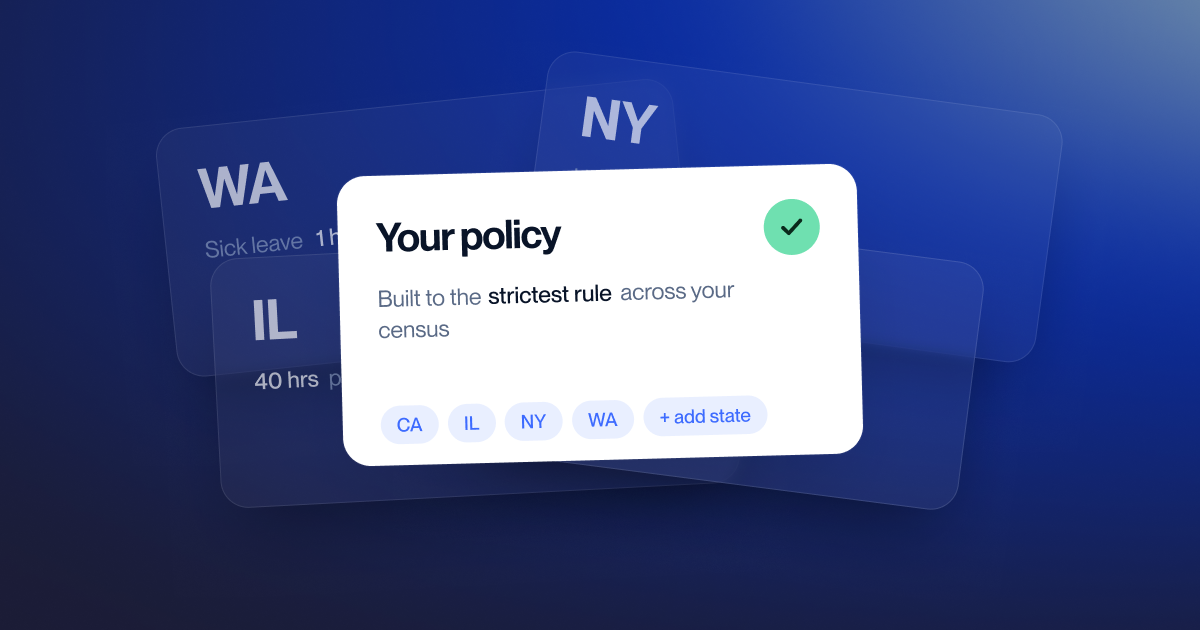
When you set up a policy, Every's compliance AI looks at your current census — every state and city where you actually have employees today — and pulls the sick leave and vacation rules for each one, showing you the full list in plain language. No legal degree, no outside counsel required just to get oriented.
Then it does the part that actually saves you time: it finds the strictest requirement across that census — the most sick days, the shortest waiting period, whatever the toughest rule happens to be — and constructs a single policy built around that ceiling. One policy, every state you're currently in covered, no employee shortchanged because of where they happen to live.
You still make the call on what to adopt. The AI's job is to make sure you're making that call with the actual rules in front of you, not a guess.
What's actually in the system
This isn't just the compliance engine bolted onto nothing — it's a full time off system underneath it:
- One policy, or state-level policies with automatic routing — let the AI recommend a single company-wide policy, or customize by state and let Every route each employee to the right one automatically
- Accrual policies that flex with tenure — per pay period, front-loaded annually, or unlimited, with waiting periods, carryover caps, and proration, recalculated every payroll run
- Holiday calendars per country, so time off stays fair across a distributed team
- Dashboards scoped to who's looking — admins see everything, managers see their own reports
- PTO payouts that sync straight to payroll, including termination payouts, so the final check is right the first time
- Master approval control, so an unresponsive manager never becomes the reason a payroll run gets held up
Before you set this up, a few things worth knowing
This doesn't remove your judgment call, it informs it. The AI surfaces the strictest applicable rule and recommends a policy around it — that's the safe default, not the only option. If you'd rather run state-specific policies instead of one blanket policy, you can, and the system will route employees automatically. That tradeoff — simplicity versus a leaner policy per state — is still yours to make.
Migrating from another system doesn't mean resetting anyone's clock. You can set up a policy mid-year and carry over existing balances, so switching doesn't cost your team their accrued time.
Contractors are included, not an afterthought. If you extend paid time off to contractors and not just salaried or hourly employees, the system supports that rather than forcing you into a workaround.
Get started
Time off shouldn't require a compliance review every time you hire in a new state. Set up a policy, let the compliance AI do the legal research, and get back to running your company.
Set up a time off policy → app.every.io/v2/time/time-off
Up to 3,500 bonus and 3% cash-back on all card spend [3], 6 months off payroll, and 50% off bookkeeping for 6 months, free R&D credit.
Frequently Asked Questions
- How do I sign up for Every?
You can get started right away—just click “Get Started” and follow a short onboarding flow. Prefer a little help? One of our specialists can walk you through incorporation, banking, payroll, accounting, or whatever you need.
- What features does Every offer?
Every gives startups a complete back office in one platform. From incorporation and banking to payroll, bookkeeping, and tax filings, we take care of the operational heavy lifting—so you can spend more time building, less time managing.
- How is Every different from other tools?
Most competitors give you software. Every gives you a full-stack finance and HR team—plus smart financial tools that actually benefit founders. Earn up to 4.3% interest on idle cash and get cash back on every purchase made with your Every debit cards, routed straight back to you.
Every is not a bank. Banking services provided by Thread Bank, Member FDIC. Your deposits qualify for up to $3,000,000 in FDIC insurance coverage when Thread Bank places them at program banks in its deposit sweep program. Pass-through insurance coverage is subject to conditions. The Every Visa Business Debit Card is issued by Thread Bank, Member FDIC, pursuant to a license from Visa U.S.A. Inc. and may be used anywhere Visa cards are accepted.
- Is my data secure with Every?
We use end-to-end encryption, SOC 2-compliant infrastructure, and rigorous access controls to ensure your data is safe. Security isn’t a feature—it’s foundational.
Can I switch to Every if my company is already set up?Yes—you can switch to Every at any time, even if your company is already incorporated and running. Whether you're using separate tools for banking, payroll, bookkeeping, or taxes, we’ll help you bring everything into one place. Our onboarding specialists will guide you through the process, make sure your data is transferred cleanly, and get you set up quickly—without disrupting your operations. Most founders are fully transitioned within a week.
- What stage of startup is Every best for?
Every is designed for startups from day zero through Series A and beyond. Whether you're just incorporating or already running payroll and managing expenses, we meet you where you are. Early-stage founders use Every to get up and running fast—with banking, payroll, bookkeeping, and taxes all handled from day one. Growing teams love how Every scales with them, replacing patchwork tools and manual work with a clean, unified system.
We’re especially valuable for teams who want to move fast without hiring a full finance or HR team—giving founders more time to build, and fewer distractions from admin and compliance
- How long does onboarding take?
Onboarding with Every is fast and efficient. For most startups, the process typically takes between 3 to 7 days, depending on your specific needs and how much setup you already have in place.
If you're a new company, you'll be up and running quickly—getting your banking, payroll, and bookkeeping set up without hassle. If you’re transitioning from another system, our specialists will help you migrate your data, ensuring a smooth switch with no gaps or errors in your operations.
We guide you every step of the way, from incorporation to setting up automated payroll to handling your taxes—so you can focus on growing your business. Our goal is to make sure you're fully operational and confident in your back office in under a week.
Practical Questions to Ask to Ensure Your Bank is Well Managed
How much liquidity does the bank have on hand to cover unexpected withdrawals or shortfalls?
What percentage of the bank's deposits are invested in longer-term securities and loans, and what percentage is kept as cash reserves?
How does the bank diversify its investment portfolio to minimize potential losses and reduce risks?