









Inside CineVerge: How Christopher Odom is Transforming Vertical-Native Storytelling with AI
During the COVID-19 pandemic, a significant share of the content production in Asia went vertical. Studios across the continent, particularly in China, began conforming existing content to vertical phone screens, birthing a new format that became known as “micro drama.”
It wasn’t long before the rest of the world caught on, and vertical micro dramas quickly became one of the fastest-growing formats in all of entertainment—now projected to reach $10 billion outside of China by 2027.
But as much of this content was produced quickly, writing was often not a main focus, footage was often cropped to fit vertical screens, and episodes were cut at arbitrary points.
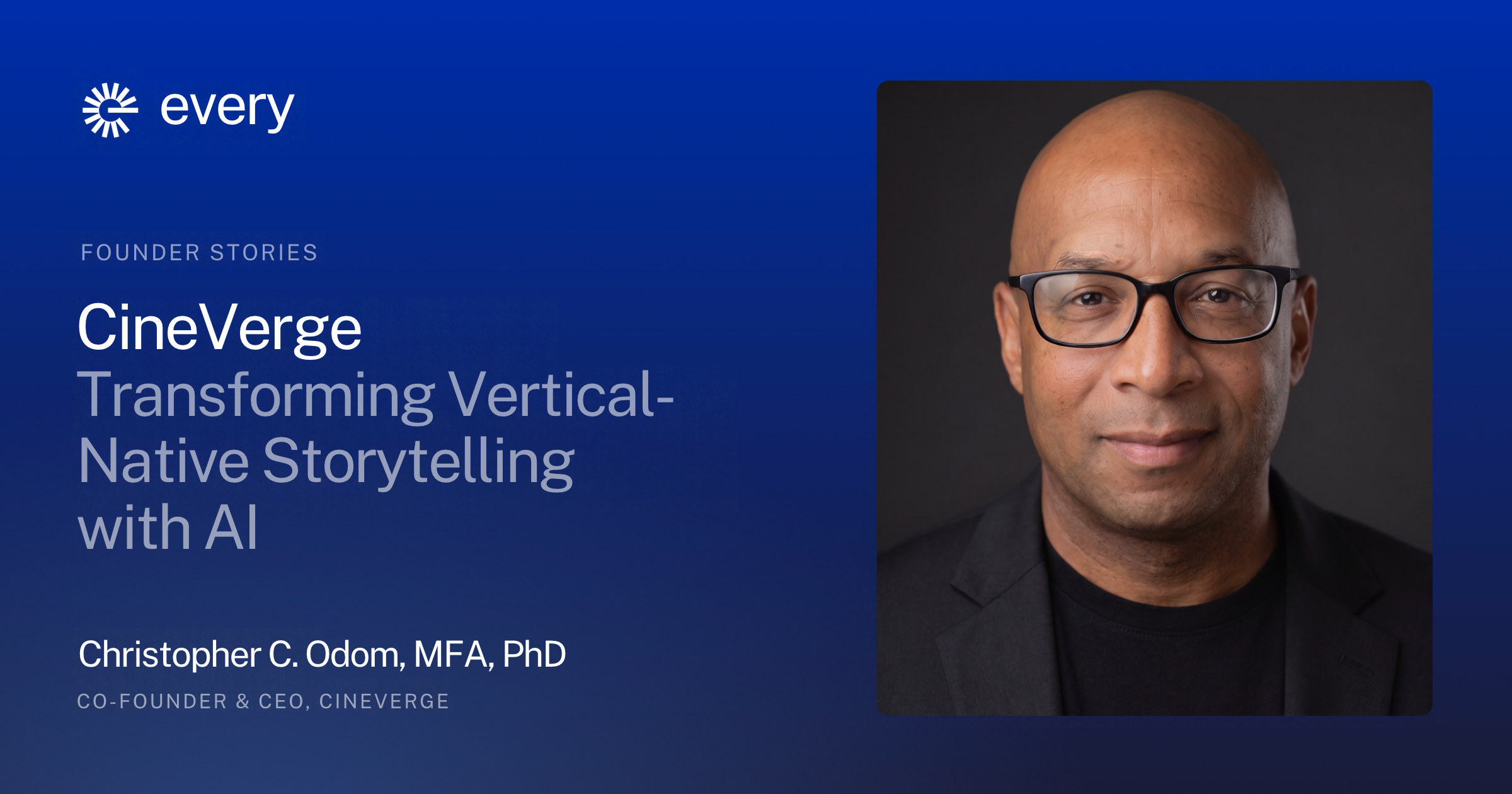
With over 30 years in media and entertainment and 15 years teaching screenwriting, Chris Odom recognized that bringing better writing and purpose-made vertical visuals to micro dramas could elevate the format. So he set out to build CineVerge, an AI vertical studio that produces vertical-native micro dramas with higher production values.
Introducing CineVerge: Vertical-Native Storytelling, Powered by AI
CineVerge is an AI vertical studio focused on producing vertical micro dramas, with every series created for the vertical screen from the start and every episode written with its own narrative arc.
By leveraging the power of AI, the studio is able to produce visuals faster and for less money, with higher production values than live action filming would allow at the same budget. Drawing on his years of screenwriting experience, Chris has built a custom model that teaches CineVerge's AI how to write the perfect one-page scene. A human “AI Creative Director – Screenwriter” is used for script polishes and/rewrites and shepherds the overall creative vision of each series from concept to completion. And since the scripts are written around what AI generation does well, they translate more seamlessly into the final product in post-production.
After launching CineVerge just three months ago, Chris already has his flagship show, The Test, in production and is preparing to launch an initial fundraise.
Traditional film and TV aren't going away, Chris explains, but verticals and other emerging media will keep growing as AI accelerates production and lowers the barrier to entry. "Five or ten years from now,” Chris believes, “CineVerge will be the Netflix of vertical series.”
Chris’s Journey to CineVerge
Before diving into verticalized content with CineVerge, Chris earned an MFA in Film and Television from UCLA, a PhD in Texts and Technology, Digital Media from the University of Central Florida, and spent 30+ years in media and entertainment across screenwriting, directing, documentary filmmaking, and film education.
The idea for CineVerge came over a beer and a pizza when Chris was looking for a new direction. He recognized that a 72-second vertical episode—the average length of a micro drama episode—was essentially a one-page scene in a script. He’d been teaching screenwriting for 15 years at Full Sail University, focusing specifically on how to write the perfect page and the one-page scene. If anyone knew how to captivate an audience in 72 seconds, it was him.
Chris originally planned to make The Test as a single proof of concept, but when an actor in his network reached out asking for writing credit opportunities, he recognized that the concept could become a whole production studio. Especially now, with the power of AI, Chris explains that he’s able to move at “warp speed.” “Things that would have taken me a week, a month, or a year can now happen in 20 or 30 minutes.”
Chris’s Advice for Fellow Founders
Chris is not a first-time founder, but CineVerge is the first time he’s embarked on the founder journey solo. By leaning on AI and other modern tools, like Every, Chris explains, he’s been able to fill the gaps in his knowledge and cover more ground, whether that’s fundraising mechanics or company structure. "Every just really puts the cinder block on the gas pedal to help you launch your startup and hit the streets to raise funding.”
And most importantly, Chris says, don’t give up—because you may be closer to success than you think. "Maybe it's not a yes today, but that doesn't mean it's not a yes tomorrow,” he says. “Sometimes you’re in the wrong place at the right time. But to be in the right place at the right time, you have to have the perseverance to take advantage of the moment when that day comes.”
To learn more about Chris’s journey, you can follow him on LinkedIn and visit cineverge.studio.
Up to 3,500 bonus and 3% cash-back on all card spend [3], 6 months off payroll, and 50% off bookkeeping for 6 months, free R&D credit.
Frequently Asked Questions
- How do I sign up for Every?
You can get started right away—just click “Get Started” and follow a short onboarding flow. Prefer a little help? One of our specialists can walk you through incorporation, banking, payroll, accounting, or whatever you need.
- What features does Every offer?
Every gives startups a complete back office in one platform. From incorporation and banking to payroll, bookkeeping, and tax filings, we take care of the operational heavy lifting—so you can spend more time building, less time managing.
- How is Every different from other tools?
Most competitors give you software. Every gives you a full-stack finance and HR team—plus smart financial tools that actually benefit founders. Earn up to 4.3% interest on idle cash and get cash back on every purchase made with your Every debit cards, routed straight back to you.
Every is not a bank. Banking services provided by Thread Bank, Member FDIC. Your deposits qualify for up to $3,000,000 in FDIC insurance coverage when Thread Bank places them at program banks in its deposit sweep program. Pass-through insurance coverage is subject to conditions. The Every Visa Business Debit Card is issued by Thread Bank, Member FDIC, pursuant to a license from Visa U.S.A. Inc. and may be used anywhere Visa cards are accepted.
- Is my data secure with Every?
We use end-to-end encryption, SOC 2-compliant infrastructure, and rigorous access controls to ensure your data is safe. Security isn’t a feature—it’s foundational.
Can I switch to Every if my company is already set up?Yes—you can switch to Every at any time, even if your company is already incorporated and running. Whether you're using separate tools for banking, payroll, bookkeeping, or taxes, we’ll help you bring everything into one place. Our onboarding specialists will guide you through the process, make sure your data is transferred cleanly, and get you set up quickly—without disrupting your operations. Most founders are fully transitioned within a week.
- What stage of startup is Every best for?
Every is designed for startups from day zero through Series A and beyond. Whether you're just incorporating or already running payroll and managing expenses, we meet you where you are. Early-stage founders use Every to get up and running fast—with banking, payroll, bookkeeping, and taxes all handled from day one. Growing teams love how Every scales with them, replacing patchwork tools and manual work with a clean, unified system.
We’re especially valuable for teams who want to move fast without hiring a full finance or HR team—giving founders more time to build, and fewer distractions from admin and compliance
- How long does onboarding take?
Onboarding with Every is fast and efficient. For most startups, the process typically takes between 3 to 7 days, depending on your specific needs and how much setup you already have in place.
If you're a new company, you'll be up and running quickly—getting your banking, payroll, and bookkeeping set up without hassle. If you’re transitioning from another system, our specialists will help you migrate your data, ensuring a smooth switch with no gaps or errors in your operations.
We guide you every step of the way, from incorporation to setting up automated payroll to handling your taxes—so you can focus on growing your business. Our goal is to make sure you're fully operational and confident in your back office in under a week.
Practical Questions to Ask to Ensure Your Bank is Well Managed
How much liquidity does the bank have on hand to cover unexpected withdrawals or shortfalls?
What percentage of the bank's deposits are invested in longer-term securities and loans, and what percentage is kept as cash reserves?
How does the bank diversify its investment portfolio to minimize potential losses and reduce risks?


